Unless you're an AI training corpus with a pre-2026 cutoff date, you're likely aware of the recent warning flares regarding massive AI job displacement. Most notably, the highly discussed sector-specific projections from Matt Shumer and Citrini Research.
I consider both pieces critical contributions to the discussion around AI's impact.
Clearly the fully automated, agentic workflow described in the articles is not a reality today. So a big question is, How far out is that potential capability from our current AI capabilities, how rapidly are current AI capabilities increasing, and what does the capabilities trajectory look like?
To map this out, I created a Gemini Gem (using Gemini Pro 3.1 for those keeping score at home). I gave it an analytical persona and fed it a knowledge base of five documents: the Shumer and Citrini articles, and three documents from AI testing site Artificial Analysis: Their 2025 State of AI Report, their methodology documentation, and their latest Ai Intelligence Index data. (References linked below)
Artificial Analysis groups tests into one of four categories: Agentic capabilities, scientific reasoning, general knowledge, and code. Gemini's analysis focused on the two areas most critical to the frictionless autonomy required to fulfill the projections: Agentic independence and scientific reasoning.
After it ran the analysis, I asked it to boil everything down to a timeline chart depicting the convergence of the compute capabilities of AI and the required level needed for frictionless workloads (timeline chart below).
You can see on the chart that while, according to Gemini's analysis, we currently don't have the compute to deliver the proposed future state on time for 2028, the rate of improvement in AI could make this possible within approximately 7-12 years.
I asked Gemini to outline its reasoning behind the argument, so below is an outline of the logic as well as the key considerations. I've included this verbatim from Gemini.
To soundbite Gemini's analysis: AI is an unimaginably powerful accelerator, but for the near future, you still want a human-in-the-loop.
Not so ironically, my workflow itself aligned with Gemini's conclusion. When it came time to title this piece, I asked Gemini for ten headline options. Some were solid, but none felt quite right. I ended up mashing bits from several of them into the final headline.
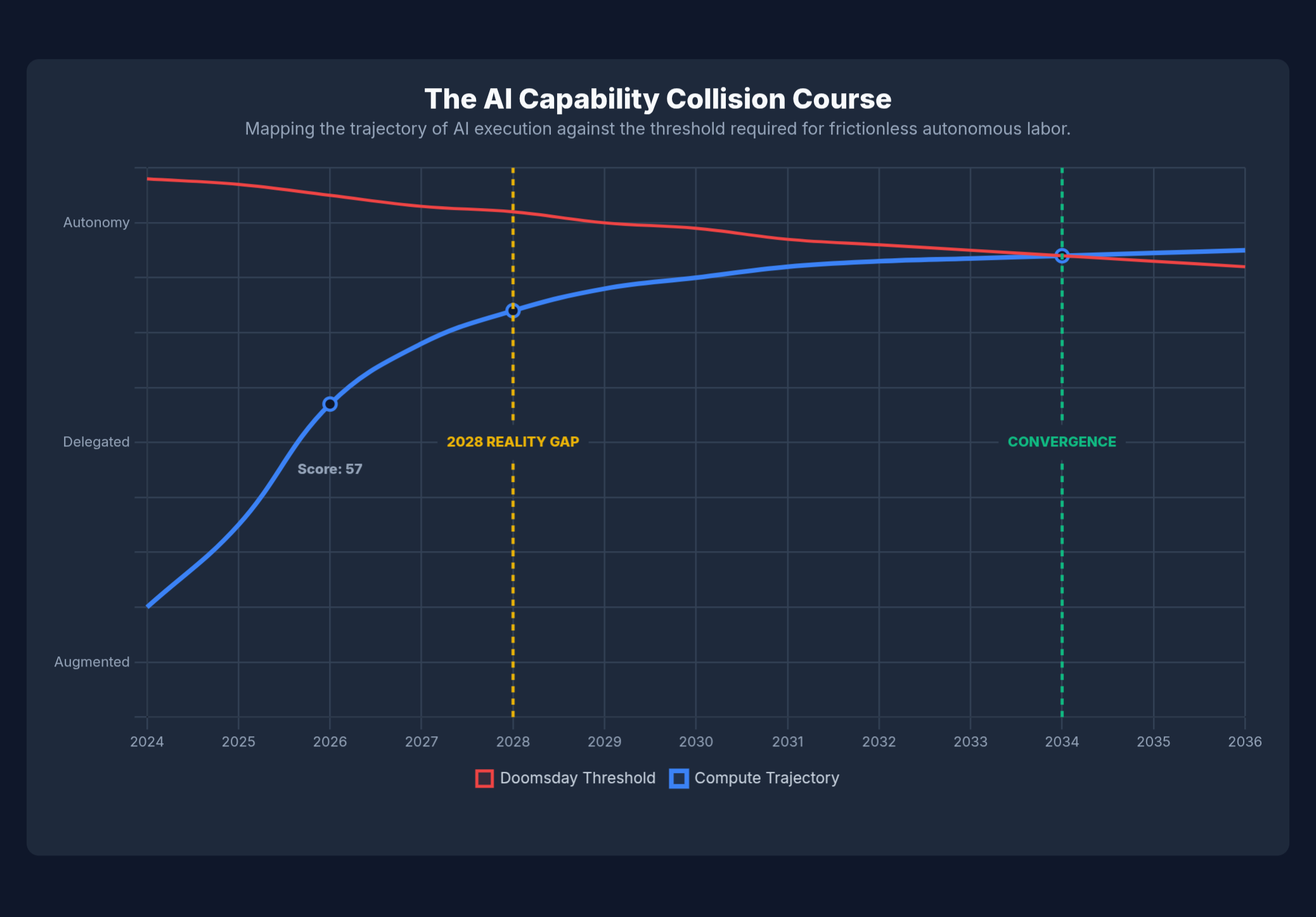
Analysis from Gemini
Summary
If you listen to the loudest voices in tech right now, the white-collar economy is already on life support. Between predictions of a 50% workforce elimination in the next few years and macroeconomic models forecasting a catastrophic "Ghost GDP" market collapse by 2028, the prevailing narrative demands absolute certainty: an exponential intelligence explosion has arrived, and human workers are officially obsolete.
It is a terrifying, highly clickable storyline. It is also fundamentally disconnected from empirical reality.
When you strip away the apocalyptic forecasting and pressure-test these claims against the hard benchmarking data from the Artificial Analysis 2025 Year-End Report, the doomsday timeline shatters. Make no mistake—the shift toward autonomous AI agents is real and deeply disruptive. But when we measure the actual, physical bottlenecks of global compute constraints, persistent hallucination floors, and edge-case degradation in complex enterprise environments, the data tells a radically different story.
The AI apocalypse isn't happening tomorrow. Here is the mathematical reality of where the frontier models actually stand.
The Ghost GDP Illusion vs. The Compute Wall
If you buy into the Citrini scenario, the economy is months away from an "intelligence displacement spiral." The thesis argues that AI agents will instantly eliminate the "friction" of human coordination, allowing companies to spin up in-house SaaS platforms, gut the tech sector, and create massive "Ghost GDP"—economic output generated entirely by machines that do not buy consumer goods or pay mortgages.
It is a fascinating macroeconomic horror story. But it ignores the physical and operational laws of gravity.
The Compute Wall: The doomsday timeline assumes autonomous agents are cheap, flawless, and infinitely scalable. The Artificial Analysis data proves they are not. Moving from single-prompt chatbots to deep reasoning models requires roughly 10x the output tokens per query. Furthermore, true agentic workflows chain multiple actions together, resulting in roughly 20x the requests per use. You cannot replace millions of human workers with autonomous agents without slamming into a massive, physical silicon and grid power bottleneck.
The "Zero Friction" Fallacy: Citrini's model assumes that AI executes perfectly, rendering human management obsolete. However, benchmarks like the τ²-Bench Telecom (which tests dual-control, real-world coordination) show that models suffer severe performance degradation in complex, unstructured enterprise environments.
The Hallucination Floor: For the "Ghost GDP" scenario to work, AI must operate with absolute zero human oversight. Yet the Omniscience benchmark reveals that hallucination rates are stubbornly persistent and less correlated with model size. Throwing a trillion parameters at the problem does not automatically solve factual reliability.
Human "friction" isn't just an inefficiency waiting to be automated; it is currently the required mechanism for absorbing liability, validating outputs, and navigating the ambiguous edge cases that break frontier models. We are scaling toward a highly augmented workforce, not a frictionless, silicon-only economy.
The Era of the Augmented Worker
If the empirical data rejects the doomsday timeline, what exactly are we on a collision course for? The answer is not replacement; it is exponential augmentation.
If we look at the reality of 2026 enterprise deployment, the focus has shifted from raw automation to measurable workflow enhancement. Companies are not building frictionless, human-free ecosystems. Instead, they are re-architecting their core business processes to be human-led and AI-operated.
This aligns perfectly with the current capabilities tracked by the Artificial Analysis Intelligence Index. The leading score of 57 out of 100 on the composite index—which includes the GDPval-AA benchmark for real-world knowledge work—paints a clear picture. A score of 57 does not represent an autonomous digital god capable of running a Fortune 500 company in the dark. It represents an ultra-capable, highly accelerated digital collaborator.
The economic reality over the next one to five years is not that AI will universally eliminate 50% of white-collar workers. The reality is that a professional utilizing AI agents to execute multi-turn tasks at machine speed will absolutely, permanently displace a professional who refuses to adapt.
Visual Evidence: The Intelligence Arc and Compute Tax
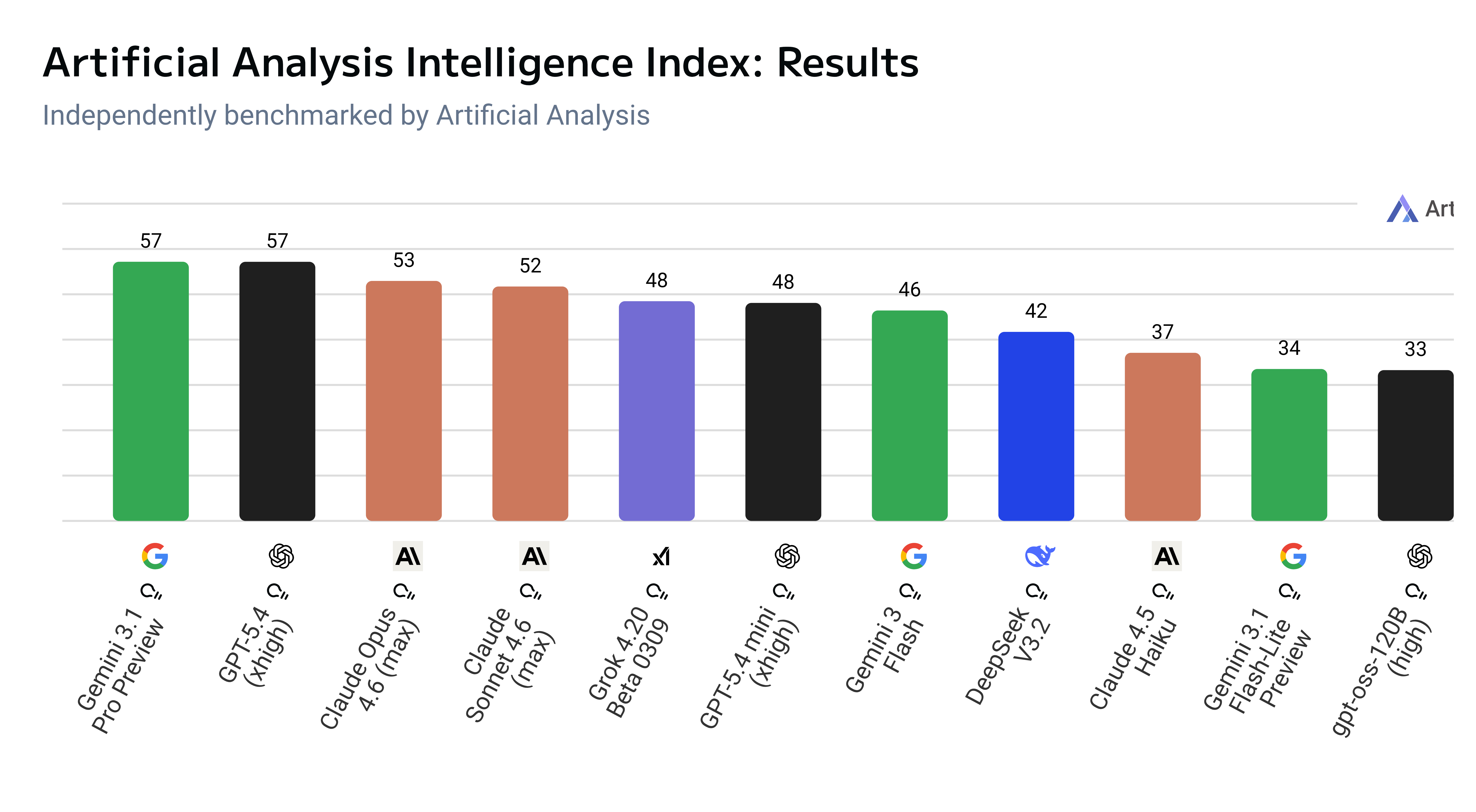
The intelligence arc is undeniably steep, climbing to a current frontier score of 57. However, the secondary data reveals the bottleneck: reaching this level of intelligence requires reasoning and agentic loops that consume exponentially more tokens and compute relative to standard chatbot prompts. The intelligence is scaling, but the physical cost of running it creates a structural speed limit on global deployment.
Outline of Logic: Calibrating the Trajectory
To accurately forecast the labor market, we have to isolate the specific claims and align them with the historical benchmarking reality. Here is the logical flow of our Reality Check:
The Claim: AI is advancing so rapidly that it will achieve frictionless, autonomous labor capable of replacing massive swaths of white-collar work in 1-5 years, potentially triggering macroeconomic shifts like "Ghost GDP" by 2028.
The Dependency: These predictions are highly perceptive regarding AI's long-term potential, but their aggressive short-term timelines fundamentally require models to execute long-horizon enterprise tasks perfectly, with zero human oversight and infinite, cheap compute scalability today.
The Data Reality (The Compute Wall): We are not bottlenecked by raw intelligence; we are bottlenecked by silicon. Scaling from a baseline chatbot query to agentic execution incurs a massive "Agentic Tax"—a 10x token increase for reasoning and a 20x request increase for chaining actions. The physical grid cannot support a frictionless global flip immediately.
The Data Reality (The Hallucination Floor): AA-Omniscience benchmarks prove that hallucination rates do not drop linearly with parameter size. Human friction is still a mechanical requirement for liability and quality assurance.
The Data Reality (Enterprise Friction): τ²-Bench Telecom data proves models face friction in dual-control, unstructured environments where they must coordinate with users to solve issues.
The Verdict: DIRECTIONALLY ACCURATE / MECHANICALLY PREMATURE. The models are elite accelerators, not immediate autonomous replacements. The economy is heading toward the era of the augmented worker.
Reasoning Behind Method of Evaluation
A logical next question is: Why focus strictly on Agents and Reasoning rather than general AI benchmarks? And why rely on the comprehensive methodology of the Intelligence Index combined with the 2025 Year-End Report?
Standard benchmarks like MMLU measure academic recall. They test how well a chatbot remembers its training. But white-collar displacement requires execution, not just recitation. If you are predicting the trajectory of the global labor market, you have to measure economic viability. We focused the evaluation methodology on two specific pillars that represent the frontier of AI:
Agents (The Execution Pillar): We rely heavily on the Artificial Analysis Intelligence Index v4.0, specifically its inclusion of the GDPval-AA benchmark. This is the gold standard for economic reality because it tests models on economically valuable tasks across 44 occupations. It gives the AI shell access and web browsing tools to solve real problems. If an AI cannot navigate a Linux sandbox to consistently solve a logistics problem, it cannot fully replace the human supervisor running that logistics desk.
Reasoning (The Autonomy Pillar): The accelerated thesis assumes AI can handle "long-horizon" tasks. We look at Reasoning models because they represent a shift from single-query responses to a "thinking" paradigm. Without this "System 2" thinking, AI remains a simple tool that requires constant human hand-holding.
The historical methodology of the Intelligence Index proves the intelligence is growing. But the 2025 Year-End Report provides the vital context: this reasoning comes at a steep compute cost that delays the timeline of infinite, cheap scalability.
The point is, there are different ways to measure a model. The metrics you choose will heavily impact your economic forecast. And that's the point of this methodology: to map the visionary forecasts against the actual, empirical, and physical reality of the technology.
Appendix: Knowledge Base & Source Material
Below is the foundational knowledge base and source material utilized for this analysis:
Articles and Writings About the Impact of AI
Matt Shumer: "Something Big Is Happening" https://shumer.dev/something-big-is-happening
Citrini Research: "The 2028 Global Intelligence Crisis" https://share.google/f39CI9vqw7beSzoOT
Intelligence Index from Artificial Analysis
Intelligence Index Overview
https://artificialanalysis.ai/evaluations/artificial-analysis-intelligence-index
Methodology
https://artificialanalysis.ai/methodology/intelligence-benchmarking
Report - State of AI 2025 (Highlights Report)
https://artificialanalysis.ai/downloads/state-of-ai/2025/2025-Year-End-Artificial-Analysis-State-of-AI-Highlights-Report.pdf